Getting faster is rarely about turning quicker. Most of the time lost in a solve happens between the moves — pausing to work out what to do next. Fixing those pauses is where real progress comes from. A solver who turns at a steady, moderate pace with no pauses will beat a solver who turns frantically but stops every few moves. That is why the fastest improvement usually comes from thinking ahead, not from moving your hands faster.
What Is Speedcubing?
Speedcubing is the hobby and sport of solving a Rubik's Cube as quickly as possible. Solves are timed, and progress is usually measured with averages rather than single lucky solves. A common format is the average of five (Ao5): you complete five solves, drop the fastest and the slowest, and average the remaining three. This gives a fair picture of your real speed. Beginners often start above two minutes and, with steady practice, work down through one minute and beyond. There is no single 'right' speed to aim for — speedcubing is about beating your own average, one small improvement at a time.
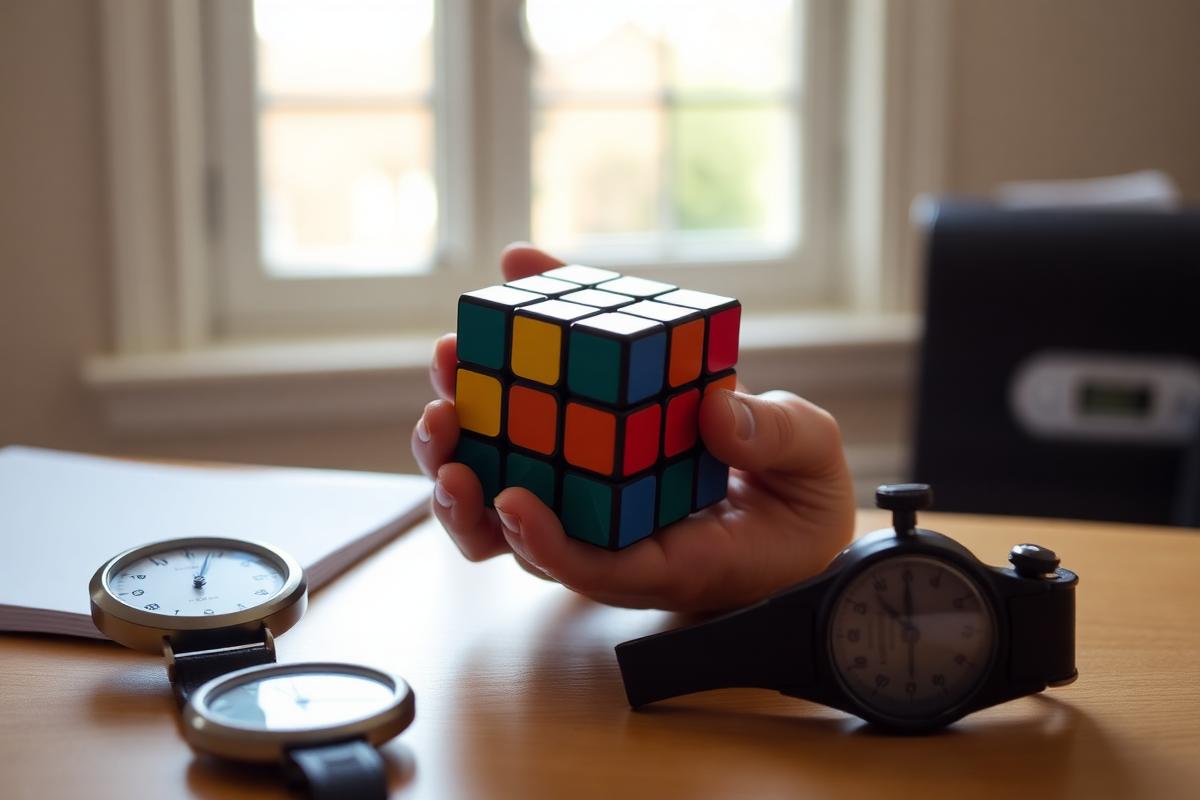
You do not need a competition or a special setup to be a speedcuber. All you need is a cube, a timer, and a method you can practise. Many cubers time themselves with a phone timer or a simple stopwatch app. What matters is consistency: timing the same way each session so your averages are comparable. A standard 3x3 cube has more than 43 quintillion possible configurations, which is why a systematic method beats random turning every time.
Why Most Solves Are Slow: The Pause Problem
When you watch a fast solver, the cube barely stops moving. When you watch a beginner, the cube stops constantly. Those stops are recognition pauses: the time it takes to find the next piece, decide what to do, and start moving again. A single solve can contain dozens of these pauses, and together they often add more time than the turns themselves. The good news is that pauses are fixable. Recognition improves with practice, and the techniques in this guide — lookahead, finger tricks, and inspection — all target the same thing: fewer, shorter pauses.
Stuck mid-solve? Get step-by-step help
Scan your cube or enter the colours manually and follow clear solving guidance for your exact configuration.
Learn Lookahead Before Speed
Lookahead means tracking the next piece you need while you are still executing the current algorithm. Practise deliberately slowly: turn at half your normal pace but never stop moving. Smooth and slow beats fast and stuttering.
Lookahead works because your hands and your eyes do different jobs at the same time. While your fingers finish one pair, your eyes should already be finding the next pair. This is hard at first because your brain wants to watch what your hands are doing. Slow practice breaks that habit. Set a timer for five minutes and solve at a pace where you never pause, even if that pace feels embarrassingly slow. Over days and weeks, your comfortable no-pause pace rises — and that rising pace is real speed.
A Simple Lookahead Drill
- Solve at half speed for five minutes, with a rule: the cube must never stop moving.
- If you cannot find the next piece, keep turning slowly anyway — the point is the habit, not the result.
- Repeat daily. After a week, raise the pace slightly and repeat.
- Use untimed solves for this drill so the clock does not push you back into pausing.
Use Finger Tricks
- Push U turns with your index finger instead of regripping.
- Use both thumbs for F and F' rather than rotating the whole cube.
- Avoid unnecessary cube rotations — each one costs time and breaks tracking.
Finger tricks are small, efficient ways to turn faces using finger pushes instead of whole-hand grips. They matter because every regrip — picking the cube up and repositioning your hands — costs a fraction of a second and breaks your tracking. A typical beginner regrips several times per solve. Cutting that down is one of the fastest free wins. The core idea is simple: use the finger closest to the face you need to turn, push it with a short flick, and let the finger return to its resting position.
Common Finger Tricks Worth Learning
- U with the right index finger: a quick push from the front-right edge. U' with the left index finger.
- R and R' with the right wrist and fingers: keep your thumb on the front face so the cube stays stable.
- D moves with the ring or pinky finger of either hand, using a small push from underneath.
- F and F' with the thumbs: push up or pull down without rotating the whole cube.
- Double turns (U2, R2) with a two-finger flick or two quick pushes in the same direction.
Do not try to learn every finger trick at once. Start with U and U', since those appear in almost every solve. When those feel automatic, add R moves, then D moves. Practise each one slowly until the motion is comfortable, then build speed. Sore or awkward fingers are a sign to slow down and check your grip.
Inspect Before You Start
Spend the first few seconds planning your cross entirely in your head. Starting with a plan removes the longest pause in most beginner solves.
In official competitions, solvers get 15 seconds of inspection time before starting the timer. You can use the same idea in practice: look at the cube, find the cross pieces, and plan the first moves before you touch it. Even planning just two or three cross pieces in advance removes the worst pause of the solve — the one right at the start, when you are still figuring out what to do. As you improve, try to plan the full cross. With practice, you can also start noticing where your first corner-edge pair will appear.
Build a Better Cross
The cross is the first stage of most solving methods: four edge pieces placed around the centre of one face. A good cross is short, planned, and solved on the bottom face so you can watch the rest of the cube while you build it. Aim for crosses that use as few moves as possible — experienced solvers usually build a cross in eight moves or fewer. If your cross takes twelve or fifteen moves, look for a shorter route. Often a different cross colour or a different piece order saves several moves. Solving the cross on the bottom (usually the white face) also keeps the top and sides visible, which makes lookahead into the next stage much easier.
Practise the cross on its own. Do a few solves where you stop after the cross and check how many moves you used. If you can regularly build the cross in eight moves or fewer, you have a solid foundation for faster solves.
Learn F2L: The Biggest Step Up
F2L stands for 'first two layers'. After the cross, F2L solves the four corner-edge pairs that complete the bottom two layers of the cube. This stage is where most of your solve time goes, so it is also where the biggest improvements are hiding. In the beginner method, the first two layers are solved in separate steps: corners first, then edges. F2L combines them: each corner is paired with its matching edge, then the pair is inserted together. Learning F2L usually feels slower at first, because pairing pieces takes more thought than following a memorised sequence. Stick with it — once pairing becomes intuitive, F2L is faster than the beginner approach in almost every solve.
Intuitive F2L First
You do not need to memorise dozens of F2L algorithms to start. Intuitive F2L means understanding how pieces move and pairing them by watching what happens. Begin with the simplest cases: a corner and edge that are already close together, or a pair that can be joined with a few turns. Practise one pair at a time in untimed solves. Over time, your brain builds a library of 'I have seen this shape before' responses, and pairing becomes automatic. Only after intuitive F2L feels comfortable should you consider learning algorithm-based shortcuts for the awkward cases.
Move to CFOP When You're Ready
CFOP is the most widely used speedcubing method. The name is an acronym for its four stages: Cross, F2L (first two layers), OLL (orienting the last layer), and PLL (permuting the last layer). Many top solvers use CFOP, and it is often called the Fridrich method after Jessica Fridrich, who helped popularise it. You do not need to learn all of CFOP at once. A common path is: beginner method, then F2L, then 2-look OLL and 2-look PLL (simplified versions with fewer algorithms), then full OLL and PLL as you improve. Full OLL has 57 cases and full PLL has 21 cases, so there is no rush — learn a few algorithms at a time and let them settle before adding more.
If CFOP feels overwhelming, remember that every stage can be learned separately. You can use F2L with a beginner-style last layer, or learn 2-look OLL while keeping the rest of your method the same. Speedcubing is not all-or-nothing; each upgrade pays off on its own.
Practise With a Plan
Random practice produces random results. A simple weekly structure works better. Do a mix of: untimed slow solves for lookahead, timed solves for measuring progress, and short drills for specific weaknesses. For example, spend one session on cross-only practice, another on a single F2L case that keeps tripping you up, and another on full timed solves. Ten focused minutes a day beats an hour of unfocused turning once a week.
- Slow solves: no timer, no pauses. Build the lookahead habit.
- Timed solves: measure your average, not your best single.
- Drills: repeat one algorithm or one F2L case until it feels automatic.
- Review: after a bad solve, ask what actually went wrong — a pause, a regrip, or a wrong move?
Practise smarter, not just faster
Use the virtual cube to practise move sequences and follow step-by-step guidance for real scrambles.
Take Care of Your Cube
A cube that turns badly will slow you down no matter how good your technique is. Keep your cube clean and properly tensioned. If it feels stiff, gritty, or catches on turns, it may need cleaning or a small tension adjustment. A light, cube-safe lubricant can make turning smoother — use only products made for speed cubes, and apply sparingly. You do not need an expensive cube to improve; a clean, well-adjusted budget speed cube is enough for most cubers. What matters is that the cube turns smoothly and does not lock up mid-solve.
Track Your Times
Record averages, not single solves. A best-of-five average tells you far more about your consistency than one lucky run, and it makes small improvements visible.
Use the average of five (Ao5) as your main benchmark. It smooths out lucky scrambles and bad luck alike. For longer-term tracking, an average of twelve (Ao12) or an average of a whole session is even more reliable. Write your averages down, or use a timer app that logs them. When you can see your Ao5 drop from 90 seconds to 75 to 60 over several weeks, that is real progress — even if your single best solve barely changes.
Common Mistakes That Slow You Down
- Rotating the cube to see the other side instead of using finger tricks — each rotation costs time and breaks your tracking.
- Turning as fast as possible from the first move, then pausing for seconds to find the next piece.
- Skipping inspection and starting the solve with no plan.
- Learning too many algorithms at once instead of mastering a few.
- Gripping the cube too tightly, which makes turns stiff and tiring.
- Comparing your times to world-class solvers instead of your own past averages.
How an App Can Help You Get Faster
An app will not make you a speedcuber on its own, but it can remove friction from practice. If you get stuck mid-solve, you can scan your cube or enter the colours manually and get step-by-step guidance for that exact configuration, which helps you understand what the next stage should look like. The virtual cube is useful for practising move sequences and notation without picking up the physical cube. And when you are learning a new method, following guided solutions helps you see how stages like F2L and the last layer fit together.
Use the app as a training partner: scan a scrambled cube, study the solution stages, then try the same solve yourself without help. Over time, the patterns become familiar and you need the guidance less and less.
Ready to beat your own average?
Download Rubik's Cube Solver and practise with step-by-step guidance, scanning, and a virtual cube.
Frequently Asked Questions About Speedcubing
Here are answers to the questions beginners ask most often about getting faster.