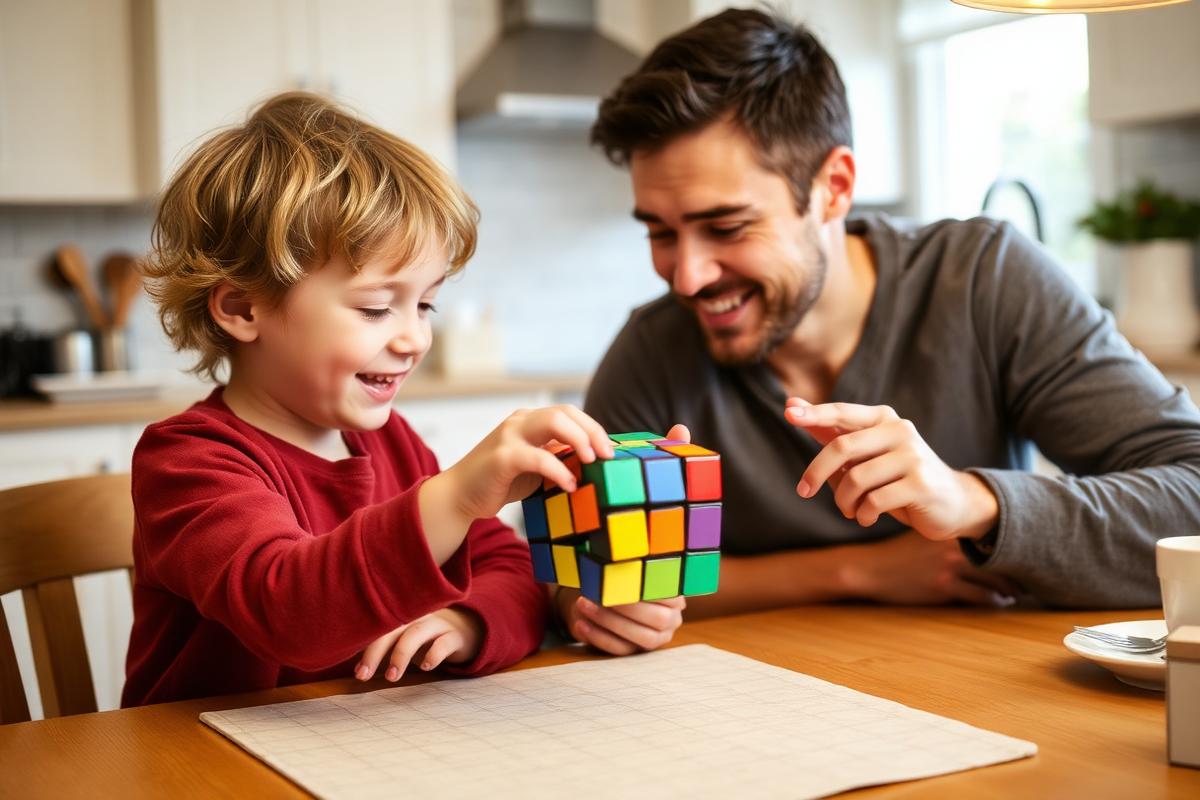
Children pick up the cube surprisingly quickly when the goal is broken into small wins instead of one intimidating puzzle.
Is your child ready?
Readiness matters more than age. A child is ready when they can follow multi-step instructions, sit with a tricky task for a few minutes without giving up, and show genuine interest in the cube. If they can follow a recipe, build a small model, or finish a jigsaw puzzle, they can probably start the white cross. If those things still feel overwhelming, wait a few months — the cube will still be there.
If your child is not ready for solving, they can still enjoy the cube. Let them turn the faces freely, match colours, and make patterns. This builds familiarity with how the pieces move, which makes the formal method much easier later. There is no rush: a child who starts happily learns faster than one who starts early.
Start with one stage only
The white cross is a complete, satisfying milestone on its own. Let it be the goal for the first few sessions and celebrate it before introducing anything else.
Treat the white cross as a game, not a lesson. Challenge your child to find all four white edges, then place them one at a time. Praise the specific win — 'You matched the white-blue edge to the blue centre!' — rather than a general 'well done'. Specific praise teaches them what they did right, so they can repeat it.
Choose a cube kids can actually turn
A child's cube should be a standard 3×3 that turns smoothly with light finger pressure. Avoid stiff novelty cubes, very small keychain cubes that are hard to grip, and cubes with peeling stickers. If possible, let your child choose the colour or style — a cube they picked themselves is a cube they want to pick up.
Make the algorithms memorable
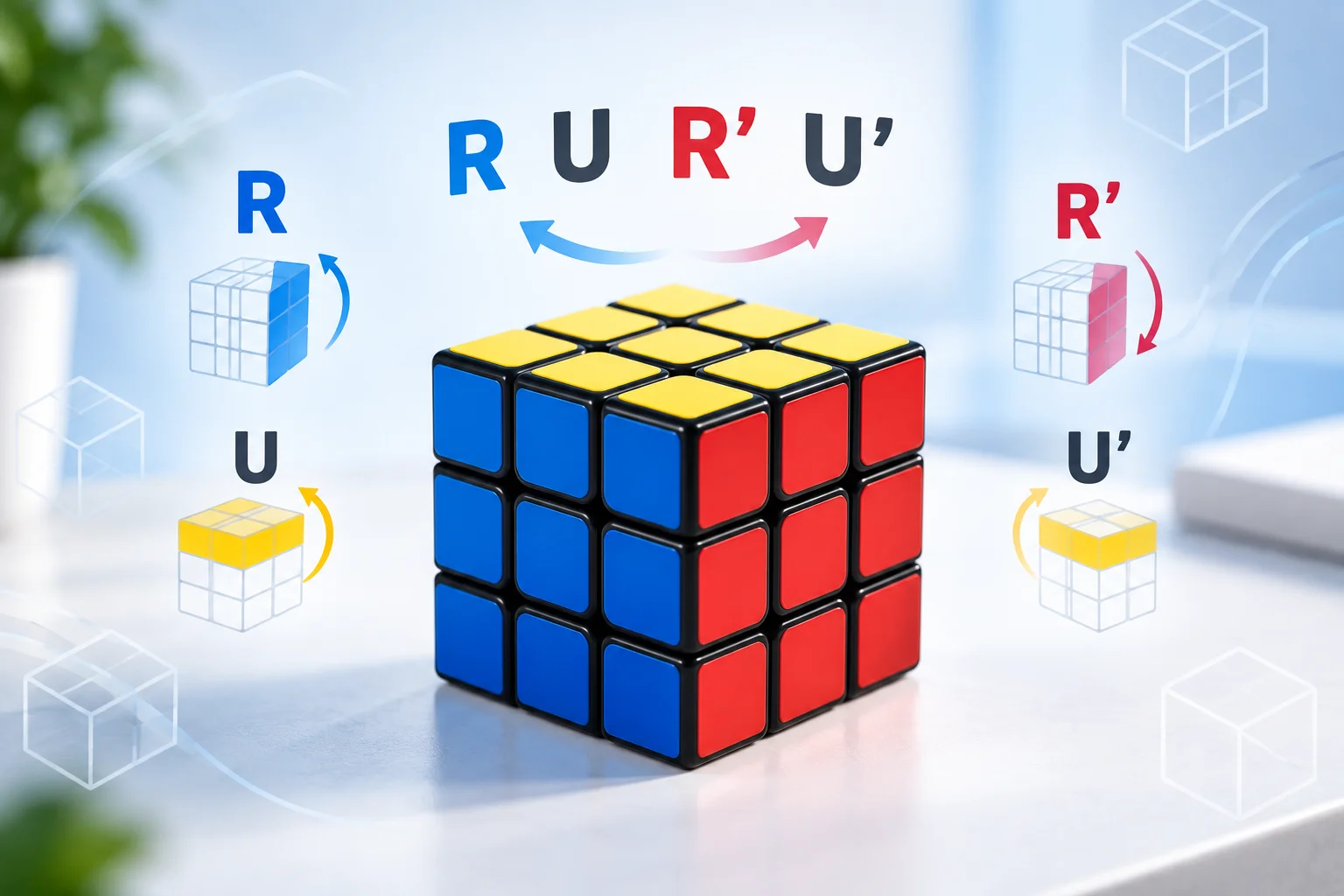
- Give sequences names, like 'the elevator' for R U R' U'.
- Say the moves out loud together while turning.
- Keep practice sessions short — ten focused minutes beats an hour of frustration.
Give each sequence a name your child invents — 'the elevator', 'the rollercoaster', 'the twist'. Saying the moves out loud together while turning builds rhythm and memory. Some families clap or tap the table on each move. The sillier the name, the better it sticks, because the sequence becomes a story rather than a code.
Turn practice into games
Games turn repetition into play. The cube is a toy first and a puzzle second, and children practise far longer when it feels like a game. Keep the games short, cooperative rather than competitive at first, and always end on a win — even a small one — so the session finishes with a smile.
- Cross race: who can build the white cross first — you or your child?
- One-face challenge: make one whole face a single colour.
- Spot the piece: call out a piece ('white-blue edge') and race to find it.
- Copy me: you make a move, your child copies it.
As skills grow, add gentle challenges: a sticker chart for each stage completed, a friendly race with a sibling, or a 'teach me' session where the child explains a stage to you. Teaching is one of the strongest ways to lock in learning — and children love being the expert.
How long should practice sessions be?
About ten focused minutes is plenty for most children. Short, regular sessions build skill better than one long session that ends in frustration. Daily practice beats a weekend marathon, because the brain consolidates the patterns between sessions. If your child asks to keep going, let them — but end while it is still fun, not when it turns into a slog.
Watch for the signs that a session should end: sighing, random turning, or saying 'this is boring'. Those usually mean tiredness, not lack of ability. Stop, do something else, and come back tomorrow. A rested child learns faster than a frustrated one.
Handle frustration before it becomes quitting
Frustration is part of learning, not a sign of failure. The cube is supposed to be hard — that is why finishing feels so good. When frustration appears, shrink the goal: go back to a stage your child has already mastered and let them succeed at it. Praise effort and strategy ('You kept checking the centres — that was smart') rather than speed. Never compare siblings or friends; comparison turns a personal win into a race.
Never let a stuck cube end the session
Scan the cube together and follow step-by-step guidance so your child keeps momentum instead of starting over.
Use a solver as a safety net
Getting stuck halfway is the most common reason kids give up. Scanning the cube and following a suggested path forward keeps momentum without restarting from scratch.
When your child is genuinely stuck, scan the cube together and follow the suggested path. Read the moves out loud, take turns making them, and watch the cube improve. Use the app as a coach, not a crutch: let your child make the moves and spot the patterns. Over time, reduce the help — first the app shows the whole solution, later it only helps with the tricky stage.
Learn alongside them
Learning alongside your child is one of the most effective things you can do. It models persistence: your child sees that adults also find things hard and keep going. It also means you can help with the tricky stages without taking over. Solve together, celebrate together, and let your child be the one who makes the final moves.
When you are both stuck, say so out loud: 'Hmm, this stage is tricky — let's figure it out together.' That sentence teaches your child that being stuck is a normal part of solving, not a personal failure. Work through it as a team and the win belongs to both of you.
What if your child wants to quit?
If your child says they want to quit, pause before reacting. Ask whether they are tired, bored, or stuck — the fix is different for each. Tired means stop for today. Bored means try a game. Stuck means shrink the goal or use the solver safety net. If they truly want to stop, let them — and leave the cube visible on a shelf. Many children come back to it weeks later, on their own terms, and that self-chosen return is more powerful than any forced lesson.
A simple first-week plan
A gentle first week keeps the goal small and the wins frequent. Each day has one job. If a day's job takes two days, that is fine — the plan is a guide, not a deadline.
- Day 1: explore the cube — turn faces, find the centres, match colours.
- Day 2: build the white cross with help.
- Day 3: build the white cross alone.
- Day 4: add the white corners and finish the first layer.
- Day 5: practise the first layer until it feels easy.
- Day 6: try the middle layer with help.
- Day 7: free play — games, patterns, or a full solve with the solver's help.
Why it is worth it
Beyond the party trick, the cube builds patience, spatial reasoning and the habit of solving a big problem by breaking it into stages.
The benefits go beyond the party trick. The cube teaches patience: progress comes from steady effort, not instant answers. It builds spatial reasoning: children learn to picture how pieces move in three dimensions. And it teaches a life skill — breaking a big, scary problem into small stages and finishing them one at a time. A child who solves a cube knows, from experience, that hard things can be solved.
Make solving a family win
Scan the cube together and follow step-by-step guidance so your child never has to quit mid-solve.
Building confidence with small wins
Confidence is the real goal of the first few sessions, not the solve itself. A child who believes 'I can do the white cross' will come back tomorrow. A child who believes 'I am bad at this' will not. That is why the wins need to be small, frequent, and clearly named. When your child places the first white edge correctly, say exactly what they did: 'You found the white-blue edge and matched it to the blue centre.' Specific praise tells them what worked, so they can repeat it. General praise — 'good job' — feels nice but teaches nothing.
Keep a visible record of progress. A sticker chart on the fridge, a photo of the finished white cross, or a simple checklist of stages gives your child proof that they are improving. On a bad day, point at the chart: 'Look, last week you could not do the cross, and now you do it in a minute.' That evidence matters more than any pep talk, because it comes from their own history.
What to do when they plateau
Every learner hits plateaus — stretches where practice does not seem to help and the same stage keeps failing. Plateaus are normal and temporary, but they are also where most children quit. The key is to change something rather than repeating the same failing approach. If the middle layer keeps going wrong, go back to the first layer for a session and rebuild confidence. If a sequence will not stick, give it a silly name, say it out loud, or teach it to a stuffed toy. Changing the format often unblocks what repetition could not.
A short break can help too. A day or two away from the cube lets the brain consolidate what it has learned. Many children come back from a break noticeably better, because the patterns have settled. If your child is frustrated, suggest a break rather than pushing through — the cube will still be there tomorrow, and a rested child learns faster than a frustrated one.
Cube clubs, competitions, and friends
Solving is more fun with other people. If your child's school has a cube club, encourage them to join — learning alongside peers is motivating, and children teach each other tricks that adults would never think of. If there is no club, a kitchen-table race with a sibling or a friend can provide the same energy. The goal is not to win but to share the hobby: two children solving together will practise longer than either would alone.
Competitions exist for children too, and they are friendlier than most parents expect. Local cubing events welcome beginners, and the atmosphere is encouraging rather than cutthroat. A child does not need to be fast to enjoy a competition — the point is meeting other cubers, seeing different cubes, and feeling part of a community. If your child shows interest, look for a local event and go along as a spectator first.
Screen time versus cube time
The cube is one of the few toys that competes with screens on their own terms: it is tactile, it has clear goals, and it rewards persistence. You do not need to ban screens to make room for the cube. Instead, treat the cube as the default 'boredom' activity: keep it on the coffee table, in the car, or by the bed, where it is easier to reach than a phone. Many families find that once a child can solve the first layer, they pick up the cube voluntarily, because finishing a stage feels better than scrolling. The cube does not need to replace screen time entirely — it just needs to be within reach when boredom strikes.
Frequently asked questions
Here are the questions parents ask most often about teaching children to solve a Rubik's Cube.