Cube notation is a compact language for describing turns. Once you can read it, every tutorial, algorithm sheet and app instruction becomes immediately usable.
What Is Cube Notation?
Cube notation is a standard written system for describing Rubik's Cube moves. Instead of saying 'turn the right side up' or 'twist the top layer to the left', notation uses a single letter for each face and a small symbol for the direction. This makes it possible to write down an entire solution — dozens of moves — in one short line. The system used today is often called Singmaster notation, after David Singmaster, who proposed it in the early 1980s. It is used in tutorials, algorithm sheets, competition resources, books, and solver apps, so learning it once unlocks every other resource.
Notation is not a solving method on its own. It is the language that solving methods are written in. The beginner method, CFOP, and every other method all use the same notation, so the investment pays off no matter which method you learn.
The Six Face Letters
- R — the right face
- L — the left face
- U — the up face
- D — the down face
- F — the front face
- B — the back face
Each letter names one of the cube's six faces: right, left, up, down, front, and back. The faces are named from your point of view as you hold the cube, with the front face toward you. This matters because 'front' changes when you rotate the cube — if you turn the whole cube to the left, a different face becomes the front. That is why algorithms always start by telling you how to hold the cube, or assume you keep it in one orientation throughout.
How to Hold the Cube
Before reading any algorithm, settle the cube in your hands and decide which face is front. Most tutorials assume the front face is the one facing you and the up face is on top. Keep the cube in that orientation for the whole algorithm. If you rotate the cube halfway through, the letters no longer refer to the faces you think they do, and the algorithm will not work. When you are starting out, it helps to say the face names out loud as you read: 'right, up, right-prime, up-prime' for R U R' U'.
Follow solutions move by move
Rubik's Cube Solver shows solutions in this same standard notation, with step-by-step guidance you can follow at your own pace.
Direction Modifiers
A plain letter means a quarter turn clockwise, looking directly at that face. An apostrophe (R') means the same turn counter-clockwise. A 2 (R2) means a half turn — direction does not matter.
Clockwise Means 'Looking at That Face'
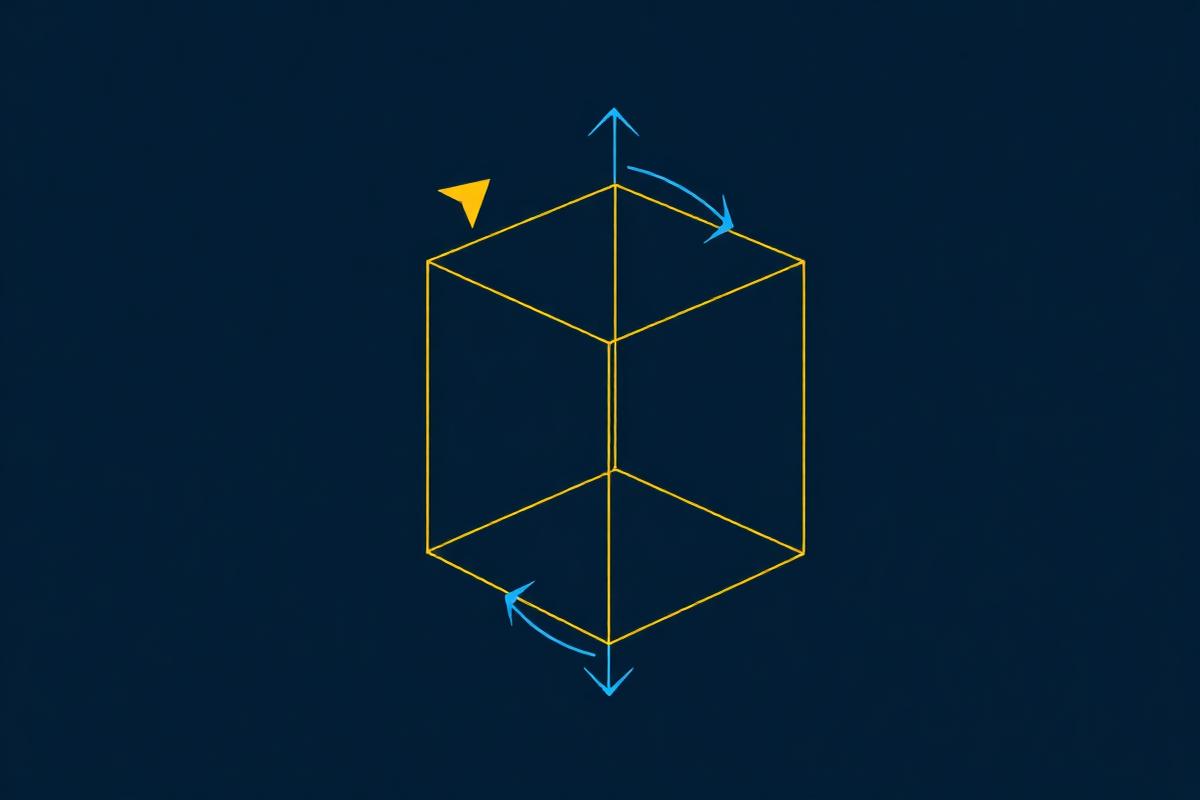
The most common beginner confusion is clockwise versus counter-clockwise. The rule is simple: imagine you are looking straight at the face named by the letter. Clockwise means turning that face the way a clock's hands move from your viewpoint. R means: look at the right face, turn it clockwise. R' means: look at the right face, turn it counter-clockwise. The same logic applies to every face, including U and D, where 'clockwise' can feel backwards until you picture yourself looking at that face from above or below. If a move feels wrong, pause and check: are you picturing the turn from the named face's point of view?
The number 2 is the easiest modifier. R2, U2, or F2 all mean a half turn of that face — two quarter turns in the same direction. Because a half turn ends in the same place either way, direction does not matter for a 2 move. Many algorithms use double turns because they are fast and hard to mess up.
Reading a Sequence
R U R' U' is four separate quarter turns performed in order. Keep the cube in the same orientation for the whole sequence, otherwise the letters no longer refer to the faces you think they do.
Read algorithms left to right, one move at a time, and execute each move before reading the next. Beginners often try to memorise the whole line first, which overloads working memory. A better approach is to group the sequence into small chunks. R U R' U' is one chunk, not four unrelated moves. Once you can perform a chunk without thinking, it becomes a single unit in your hands. This chunking is exactly how solvers learn long algorithms: not as twenty individual moves, but as four or five familiar patterns joined together.
Common Short Sequences and What They Do
Two short sequences appear everywhere, so they are worth knowing by name. The first is R U R' U', often called the 'sexy move'. Repeating it six times returns the cube to its solved state, which makes it a great way to check that you are turning correctly. The second is the Sune algorithm: R U R' U R U2 R'. Sune is used to orient the last-layer corners, and it appears in both the beginner method and CFOP. Practise both slowly until the finger movements feel automatic, then gradually build speed. If either sequence scrambles your cube instead of doing what you expect, the most likely cause is a wrong turn direction or an accidental cube rotation.
Wide Moves
A wide move turns two layers at once: the face layer plus the layer next to it. Wide moves are written with a lowercase 'w' after the letter, for example Rw, Uw, or Fw. Rw means: turn the right face and the middle layer beside it together, as if they were one thick slice. Wide moves appear in some algorithms, in 4x4 and larger cube methods, and in certain last-layer cases. The direction rules are the same as for single-face moves: Rw is clockwise looking at the right face, Rw' is counter-clockwise, and Rw2 is a half turn. If you see a lowercase letter without a 'w', such as r, it means the same thing as Rw — the two notations are equivalent.
When practising wide moves, grip the cube so both layers move together. Use your whole hand or two fingers on the edge of the double layer. If only one layer turns, you have done a normal move instead of a wide move — reset and try again.
Slice Moves
Slice moves turn a middle layer of the cube — the layer between two opposite faces. There are three: M (the layer between R and L), E (the layer between U and D), and S (the layer between F and B). Slice moves follow the direction of a neighbouring face: M turns in the same direction as L, E turns in the same direction as D, and S turns in the same direction as F. The same modifiers apply: M' is counter-clockwise, M2 is a half turn. Slice moves are less common in beginner algorithms, but they appear in some last-layer algorithms and in advanced methods, so recognising them is useful.
Cube Rotations
Sometimes an algorithm asks you to reorient the whole cube instead of turning a face. These whole-cube rotations are written with lowercase letters: x, y, and z. The letter x means rotate the entire cube in the same direction as an R turn; y means rotate it as a U turn; z means rotate it as an F turn. After a rotation, the faces have new names — what was the front face may now be on top. Rotations appear in written algorithms to avoid long face-turn sequences, and in tutorials when the author wants you to look at a different side of the cube. The prime and double modifiers work the same way: x' rotates counter-clockwise, x2 is a half rotation.
Do not confuse rotations with face turns. A rotation changes nothing about the cube's state — the pieces stay in the same places relative to each other. It only changes which face is in front of you. If an algorithm suddenly stops working, check whether you missed a rotation.
Parentheses and Repetition
Long algorithms are often written with parentheses and repetition counts to keep them compact. For example, (R U R' U') x6 means 'repeat the sequence R U R' U' six times'. Parentheses group a sequence so the repetition count applies to the whole group. You may also see brackets like [R U R' U'] used the same way. Some sources use a small number after a closing parenthesis, such as (R U)3. The meaning is the same: perform the grouped moves that many times. When you see this notation, do not try to expand it in your head — perform the group, count repetitions on your fingers, and keep going.
See notation in action
Enter your cube's colours or scan it, then follow the solver's move list one step at a time.
How to Read an Algorithm From Start to Finish
Let us walk through a complete algorithm: the Sune, written as R U R' U R U2 R'. Read it as seven moves: R (right face clockwise), U (up face clockwise), R' (right face counter-clockwise), U (up face clockwise), R (right face clockwise), U2 (up face half turn), R' (right face counter-clockwise). Notice how the pattern is almost symmetric — R and R' alternate around the U turns. Recognising that rhythm helps you memorise the algorithm as a shape in your hands rather than seven separate facts.
A useful practice method is to perform the algorithm on a solved cube and watch what happens. Sune on a solved cube twists three last-layer corners. Performing the algorithm again from a different angle twists them back. This kind of experimentation builds intuition: you stop seeing notation as abstract symbols and start seeing it as instructions that produce visible changes.
Notation in Apps and Solvers
When a solver shows you a move list, it is using this notation. Understanding it means you can follow along, check your work, and eventually stop needing the visual prompt at all.
Solver apps typically display moves in the same notation you have learned here: a sequence of letters with primes and 2s. Some apps also show a 3D preview or highlight the face to turn, which is helpful while you are still learning. The virtual cube is another useful tool: you can practise entering a sequence and watch the cube respond, which connects the symbols to the physical turns. When a solver gives you a long solution, do not try to memorise it — read one move at a time, execute it, then read the next. The notation is there to guide you move by move, not to be memorised as a whole.
If you scan your cube or enter its colours manually, the solver's output will use this same notation. Knowing what R' and U2 mean turns that output from a confusing string of letters into clear instructions you can follow at your own pace.
Common Mistakes When Reading Notation
- Turning a face the wrong way because you pictured 'clockwise' from the wrong side. Always picture the turn from the named face's point of view.
- Rotating the cube in your hands mid-algorithm, which changes what each letter refers to.
- Confusing a prime (R') with a double turn (R2). A prime is a quarter turn counter-clockwise; a double is a half turn.
- Reading a wide move (Rw) as a normal face move and turning only one layer.
- Rushing through an algorithm before you can read each move confidently. Slow and correct beats fast and wrong.
Practise: Read, Then Turn
The fastest way to get comfortable with notation is short, daily practice. Pick one short algorithm, read it aloud move by move, and execute it slowly. Then scramble the cube, read the algorithm again, and execute it a second time. After a few days, the common patterns — R U R' U', Sune, and the double turns — start to feel automatic. You can also practise with a virtual cube, which lets you test sequences without worrying about losing track of a physical cube.
- Read the algorithm aloud before touching the cube.
- Execute one move at a time, checking each turn.
- Repeat the same algorithm several times in a row.
- Try the algorithm on a solved cube to see what it changes.
Ready to read algorithms with confidence?
Download Rubik's Cube Solver and follow step-by-step solutions in standard notation.
Frequently Asked Questions About Cube Notation
Here are answers to the questions beginners ask most often about reading cube notation.